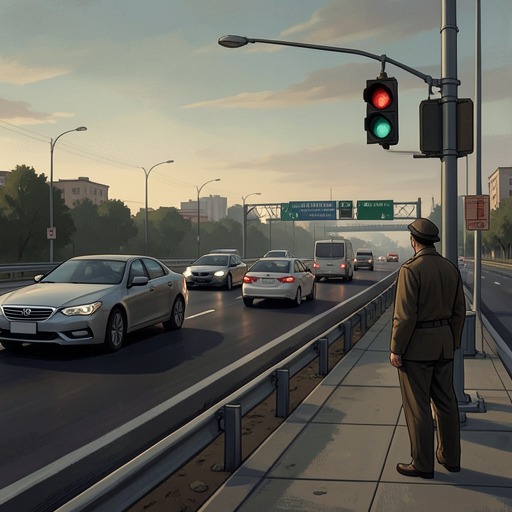
Richmond–San Rafael Bridge traffic experiment
The Wisdom of CrowdsThe Richmond–San Rafael Bridge traffic experiment was a controlled demonstration of how a small, moving bottleneck can disrupt a highway’s flow. On the morning of June 14, 2000, Carlos Daganzo and Juan Munoz sent a test vehicle onto the Richmond–San Rafael Bridge and instructed it to travel well below the surrounding traffic’s speed. Lane changing increased, congestion formed farther upstream, and the experiment showed how individual drivers’ responses to uneven traffic can reduce the performance of the road as a whole.
Background: From Free Flow to Congestion
Traffic can move freely when there are relatively few cars: drivers can change lanes, adjust speed, and keep safe distances without forcing a chain of braking. As the road fills, or vehicles slow to leave it, drivers brake to preserve those distances. The response propagates backward through traffic. In faster lanes, drivers must react sooner, and lane changes can further equalize speeds as available gaps fill. The result is an unstable pattern in which cars move more slowly than before; a small disturbance can tip it into stop-and-go traffic.
A jam is difficult to undo once it forms. Vehicles at its front leave more slowly than vehicles join at its rear, so the visible queue can travel backward along the highway. Traffic researcher Kai Nagel described such jams as stable formations that can move for hours against the direction of traffic. This persistence makes the origin of a jam consequential: the disruption may outlast the moment or obstacle that helped produce it.
The Experiment on the Bridge
The experiment addressed a dispute over where jams begin. Physicists argued that spontaneous jams could emerge from traffic in much the way flow can suddenly jam in simulations of water or falling grains of sand. Traffic engineers, by contrast, maintained that every jam had an obstacle or bottleneck behind it. The disagreement had uncertain practical implications, since even engineers accepted that a responsible irregularity could be very small, including a car moving too slowly.
Daganzo and Munoz tested that possibility on a five-and-a-half-mile bridge with two lanes in each direction and no entrance or exit ramps. On June 14, 2000, traffic during the late rush hour was moving at a healthy pace—slightly more than sixty miles per hour—when their deliberately slow test vehicle entered the flow. The effects appeared immediately: vehicles changed lanes more often, while congestion began forming farther back along the highway, or upstream. Although the bottleneck itself was moving, it significantly reduced the traffic flow.
The demonstration gave a concrete form to the engineers’ claim that a small obstruction can matter. It did not require a stationary blockage or a closed ramp: a slower vehicle within otherwise brisk traffic was enough to disturb movement on a bridge without entry or exit ramps. Its significance lay not only in the slowdown itself, but in how the disturbance spread through the choices of drivers around it.
Lane Changes and the Cost of Local Responses
Unequal speeds between lanes make drivers more likely to change lanes. Those changes, in turn, make drivers more cautious: they increase the distances they leave between vehicles. The extra space may seem to make lane changes easier, but the resulting pattern further encourages them. The book’s account connects this cycle to a striking reduction in capacity: each lane carries about 10 percent fewer vehicles than it would as a single-lane road.
The bottleneck therefore matters beyond the vehicle directly behind it. Different lane speeds invite movement between lanes; those movements alter the distances and speeds that other drivers must respond to. What begins as an attempt to move more quickly can make the whole road carry less traffic. The experiment helps explain why the effects of an obstruction are not confined to its immediate location or to a single driver’s decision.
Coordination Without a Shared View
When roads become crowded, drivers must anticipate one another, but their information is limited largely to brake lights and turn signals. These signals offer only a crude picture of what nearby drivers are about to do. A driver ready to brake can slow vehicles across the highway, while decisions about whether to exit or change lanes are made without a broader view of traffic conditions. Individual choices can thus be understandable locally yet disorderly in combination.
This is the coordination problem that the bridge experiment brings into focus. Traffic flow depends on many drivers responding to one another, but no individual driver sees the full pattern. As disturbances prompt lane changes, braking, and greater caution, the road can lose the smooth, patterned movement associated with a flock of birds and fall instead into stop-and-go disorganization. The slow test vehicle made the initiating disturbance visible; the emerging congestion demonstrated how local reactions could carry its effects upstream.
Significance and Limits
The experiment supports the practical point that a moving bottleneck can significantly disrupt traffic even when the road has no entrance or exit ramps and surrounding traffic is traveling above sixty miles per hour. It also grounds the wider argument that congestion is a coordination problem: drivers’ reactions are linked, but the signals available to them are incomplete and their view of the system is local.
The demonstration forms part of a debate rather than settling every question about traffic jams. The competing accounts distinguish spontaneous jams from jams caused by obstacles, while the engineers’ position allows the responsible bottleneck to be exceedingly small. By showing that a deliberately slow vehicle could trigger an observable disturbance on a particular bridge, Daganzo and Munoz made the bottleneck mechanism concrete. The experiment’s larger lesson is that a road’s performance depends not only on how many vehicles it carries, but on how their movements interact.